


Subscribed kids fashion is reshaping how modern families keep their children dressed — replacing exhausting mall trips and endless online scrolling with curated clothing boxes delivered directly to the front door on a recurring schedule. If you have ever scrambled to replace an entire season's wardrobe overnight because your child suddenly jumped two sizes, this model was built for you.
Subscription-based children's clothing has evolved from a novelty into a mature, competitive market covering every age bracket from newborn through tween. Today's services combine personal styling, flexible delivery schedules, and keep-what-you-love return windows to eliminate nearly every friction point in the traditional children's shopping experience.
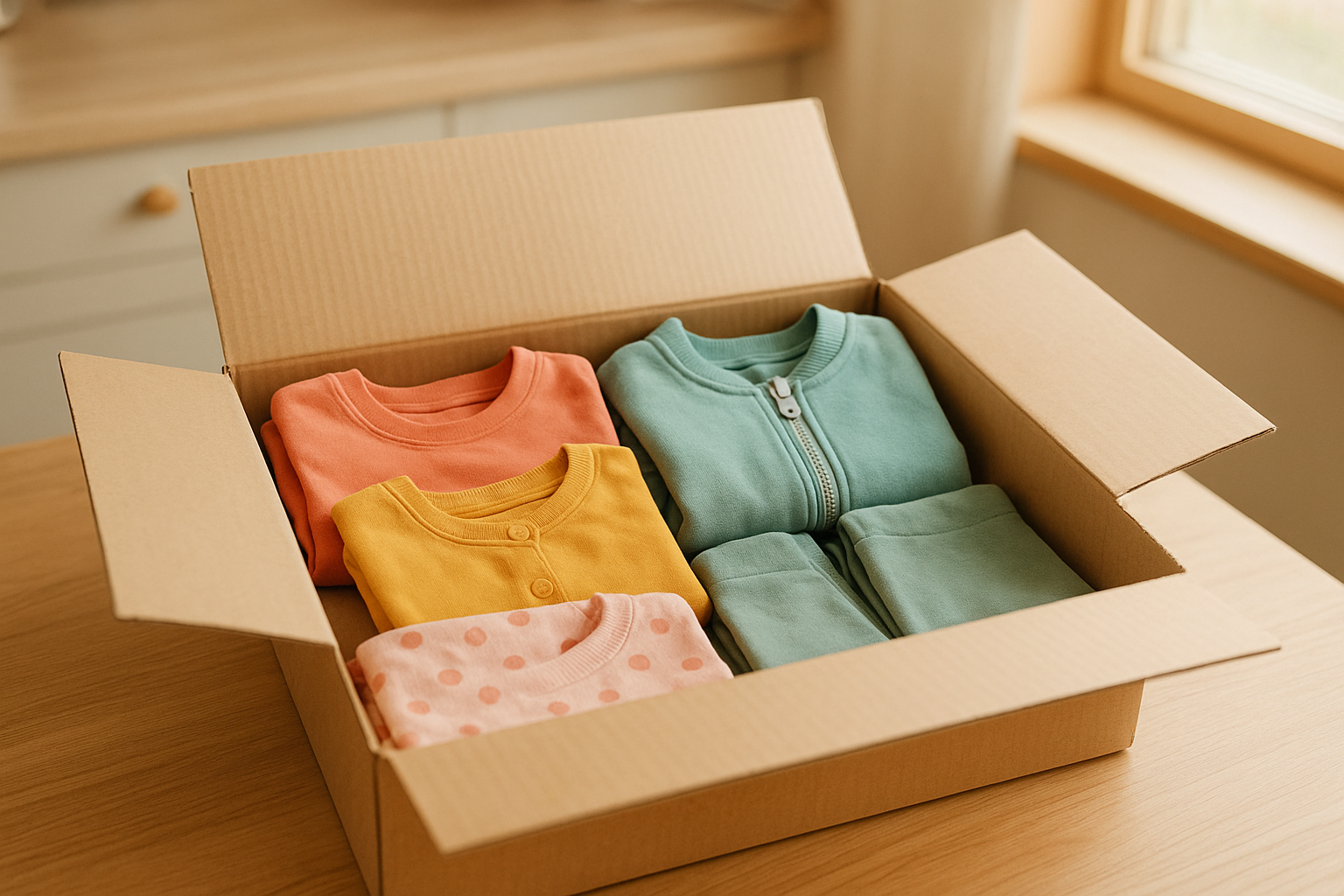
A curated box of children's clothing arrives ready to wear — subscribed kids fashion eliminates the shopping chore for busy families.
What Is Subscribed Kids Fashion — and How Does It Work?
At its foundation, subscribed kids fashion is a recurring clothing delivery service. Parents create a detailed style profile at signup covering their child's current size, preferred colors, activity level, school dress code requirements, and any specific style preferences or items to avoid. A stylist or AI-powered curation engine then selects a box of clothing and ships it on the agreed frequency.
According to Wikipedia's overview of subscription boxes, this retail model accelerated rapidly through the 2010s and has since become one of the fastest-growing segments in children's retail. What began as a convenience novelty has matured into a highly personalized service category with dozens of providers competing on curation quality, price, and delivery flexibility.
The Two Main Pricing Models Explained
Understanding how you actually pay is critical before choosing a service. There are two dominant models in the subscribed kids fashion market:
Keep What You Love
A box of items arrives. You try everything, pay only for what you keep, and return the rest within a set window (typically 5–7 days). Best for families who want maximum flexibility and are willing to manage returns.
Flat-Rate Bundles
Everything in the box is included in a single fixed price. Best for families doing a full seasonal wardrobe refresh or those who prefer predictable monthly costs without tracking returns.
Some services, including Bundle to Bundle, combine elements of both approaches — offering curated selections at flat-rate price points with easy exchange options, giving families the best of both worlds.
Why Families Are Choosing Subscribed Kids Fashion Over Traditional Shopping
The appeal of subscribed kids fashion goes well beyond convenience. Parents who make the switch consistently report benefits across time savings, wardrobe quality, and even their children's excitement about getting dressed. Here is a closer look at the most compelling reasons families are abandoning traditional shopping:
1. Radical Time Savings
Shopping for children's clothing requires knowing current sizes (which change without warning), tracking seasonal needs, comparing quality across dozens of brands, and navigating crowded stores or endless online product pages. A well-chosen subscription eliminates every single one of those tasks. Parents invest 10 to 15 minutes completing a detailed style profile once, then the service handles everything else until a profile update is needed.
2. Genuine Style Discovery
When a professional stylist or smart curation algorithm selects clothing, children often end up wearing brands and styles their parents would never have encountered independently. Many families report this as one of the most surprisingly enjoyable aspects — the box becomes a small event, and kids develop stronger personal style faster when they are exposed to a broader range of well-chosen options.
3. Multi-Child Household Simplification
For parents managing two, three, or more children across different size ranges and style preferences, the logistical complexity of traditional shopping multiplies quickly. A subscription service that handles each child's profile separately — and ships everything to a single address — can dramatically simplify wardrobe management across the household without a single trip to a store.
4. Kids Actually Participate
One frequently overlooked advantage: many subscribed kids fashion services allow children to participate in the style profile — choosing preferred colors, themes, or even specific clothing types. When kids have input into what arrives, they are significantly more likely to wear what is in the box without complaints. This turns getting dressed from a daily negotiation into a non-event.
How to Choose the Right Kids Fashion Subscription: A Complete Evaluation Framework
Not all subscribed kids fashion services are equivalent. The market ranges from budget-friendly bundle services to premium personal-styling experiences with significant price differences between them. Use the following framework to evaluate any service before committing.
The 8-Point Subscription Evaluation Checklist
- Size range coverage: Confirm the service covers your child's current size and the next two sizes up — children grow unpredictably, and a service that tops out at size 5T creates a forced cancellation point.
- Style profile depth: Look for services that ask about activity level, school dress codes, favorite colors, pattern preferences, and items to avoid — not just age and gender.
- Return policy clarity: Free, easy returns with a minimum 5-day window are the baseline standard. Any service requiring you to pay for return shipping should be a red flag.
- Pricing model transparency: Understand whether you pay per item kept or a flat bundle rate, and whether there is a styling fee charged regardless of what you keep.
- Delivery frequency options: Monthly, bi-monthly, and seasonal delivery options should all be available. A service locked to one frequency is inflexible for most families.
- Pause and skip availability: Confirm that skipping or pausing a delivery is easy and does not require calling customer service — it should be doable in your account dashboard in under a minute.
- Brand and fabric quality: Read parent reviews specifically about durability after washing. A lower per-item price means nothing if the garments fall apart after three washes.
- Trial box availability: The best services offer a low-commitment first box at a reduced price so you can evaluate the curation quality before enrolling in a full subscription plan.
Services like Bundle to Bundle are built around exactly these parent priorities — with flexible delivery scheduling, detailed customization, and transparent pricing that eliminates billing surprises.
What to Expect: The Complete Subscribed Kids Fashion Experience, Step by Step
If you have never used a kids clothing subscription before, understanding the full end-to-end experience before you sign up removes every guesswork moment. Here is exactly what happens from the moment you decide to try subscribed kids fashion to the moment a well-fitting outfit goes into your child's closet.
- Complete the style profile in detail. This is the most important step. Enter your child's current measurements (not just age), list their school's dress code requirements if any, choose preferred colors and patterns, and flag any categories to exclude — for example, if your child refuses to wear anything without a graphic print or absolutely will not touch jeans. The more specific you are, the better every future box will be.
- Select your pricing model and delivery frequency. Decide between keep-what-you-love or flat-rate bundle, and choose a delivery cadence that matches how fast your child is currently growing. Fast growers may benefit from monthly deliveries; children in stable size phases often do better with seasonal boxes.
- Receive and unbox your first delivery. The box arrives with items selected to match the profile. Most services include a card listing each item and its individual price. Have your child try everything on before making any decisions — fit impressions from holding up a garment rarely match how something actually looks when worn.
- Decide what to keep and what to return. For keep-what-you-love services, tag the items for return, place them in the prepaid packaging, and drop them at the specified carrier location before the return window closes. Mark the deadline in your phone calendar the moment the box arrives — this single habit prevents the most common billing frustration in the entire category.
- Leave feedback on every item. Every reputable service has a feedback mechanism after each box. Rate fit, style accuracy, and fabric quality for each piece. This feedback directly improves the next box's curation — skipping it is one of the most common reasons subscribers feel their boxes do not improve over time.
- Update the profile whenever something changes. Size jump, new activity, upcoming event, school dress code change — any shift in your child's life should trigger a profile update. Set a calendar reminder to review the profile at least once every two months, even if nothing obvious has changed.
Age-by-Age Guide: Which Kids Fashion Subscription Features Matter Most
The right subscription features shift significantly as children grow. What matters for a newborn's wardrobe is entirely different from what a 10-year-old cares about. Here is how to think about subscribed kids fashion at each stage.
Newborns and Infants (0–12 Months)
At this stage, children outgrow clothing faster than at any other point in life — sometimes moving through an entire size in as little as six to eight weeks. The most critical subscription features for this age bracket are frequent delivery options, a wide size progression, and soft, easy-care fabrics. Snaps and zippers matter enormously at 3 AM diaper changes. Prioritize services that specify fabric content and allow monthly or on-demand deliveries.
Toddlers (1–3 Years)
Toddlers develop strong opinions about what they will and will not wear, often centered on comfort over everything else. Scratchy collars, tight waistbands, and stiff denim are common rejection triggers. The best subscribed kids fashion services at this age allow parents to flag comfort preferences specifically — not just style preferences. Durability against high-activity play also becomes critical; look for reinforced knees and color-fast dyes.
School Age (4–9 Years)
School-age children need clothing that functions across multiple contexts: classroom days, PE class, after-school activities, and weekend socializing. The ability to specify school dress code requirements in the profile becomes essential at this stage. Services that include mix-and-match coordination across multiple pieces — so a single box creates several complete outfits — deliver dramatically better value than those shipping individual items.
Tweens (10–14 Years)
Tweens are the most opinionated demographic in children's fashion. At this stage, the quality of the style profile matters most — services should allow tweens to participate directly in setting their own preferences. Brand awareness begins to emerge, peer influence on clothing choices intensifies, and the range of contexts (school, sports, social events, casual weekends) widens further. Services with strong tween-specific options and direct-input style quizzes for the child themselves significantly outperform generic services at this age bracket.

Subscription services curate complete coordinated looks across age groups — from toddlers through tweens — so every outfit is ready to wear straight from the box.
Seasonal Wardrobe Management Made Effortless
One of the strongest structural advantages of subscribed kids fashion is how naturally it aligns with the four seasonal wardrobe transitions every family faces every year. Without a subscription, parents must remember to audit what still fits, identify gaps, and purchase replacements — all before the season turns and last year's clothes are both the wrong size and the wrong weight.
A well-timed subscription delivery arriving at the start of fall or spring eliminates that scramble entirely. The service automatically accounts for weather-appropriate fabrics, layering options, and the child's current measurements — removing the mental load of seasonal wardrobe planning from the family's plate.
Seasonal Delivery Timing Recommendations
- Late August / Early September: Fall delivery covering layers, school-appropriate pieces, and transitional fabrics.
- Late October / Early November: Winter delivery adding heavier outerwear, thermal layers, and holiday occasion pieces.
- Late February / Early March: Spring delivery with lighter fabrics, new color palettes, and active-wear for warming weather.
- Late May / Early June: Summer delivery covering warm-weather essentials, swimwear where offered, and camp-ready clothing.
Parents using a seasonal delivery cadence consistently report that they spend significantly less time thinking about clothing between deliveries — which is exactly the goal. For families with faster-growing children, supplementing a seasonal schedule with one or two additional on-demand boxes between seasons is a practical solution most services support.
Subscribed Kids Fashion and Sustainability: What You Need to Know
Children's clothing is one of the most wasteful categories in the entire fashion industry. Because children outgrow garments so rapidly — often wearing a given size for only a few months — items are frequently discarded with minimal use. Fast fashion pricing encourages quantity over quality, which compounds the problem.
Subscribed kids fashion is increasingly addressing this issue in several concrete ways:
- Resale and redistribution programs: Some services clean, inspect, and re-list returned items to new subscribers at a reduced price point, extending the useful life of each garment and reducing textile landfill contribution.
- Sustainable fabric sourcing: An increasing number of services partner with suppliers of organic cotton, recycled polyester, and other certified sustainable materials — making it possible to prioritize eco-friendly options during the style profile setup.
- Quality-over-quantity curation: By focusing on fewer, better-made items per box rather than maximizing item count, the best services encourage parents to invest in pieces that outlast the size rather than flooding wardrobes with disposable fashion.
- Minimal and recyclable packaging: Leading services have eliminated plastic polybags and excess filler material in favor of recyclable cardboard and paper-based packaging — a small but meaningful improvement over standard retail shipping.
When evaluating a service, check its website for a dedicated sustainability or environmental policy page. Services that are genuinely committed to sustainable practices publish specifics — certifications, fabric sourcing partners, or resale program details. Vague language about "caring about the environment" without concrete commitments is a reliable signal that sustainability is marketing language rather than operational practice.
How Subscribed Kids Fashion Pricing Actually Breaks Down
Price is consistently the first question parents ask before committing to a kids clothing subscription — and the answer is more nuanced than most comparison articles acknowledge. Here is an honest breakdown of what to expect across the market.
One important cost factor many comparison articles omit: some services charge a styling fee (typically $15–$25) that is credited back if you keep a minimum number of items. If you return everything, you still pay the styling fee. Always check for this charge before signing up — it significantly affects the real cost of low-keep-rate boxes.
7 Common Mistakes to Avoid With Kids Fashion Subscriptions
Even with an excellent service, parents frequently encounter frustrations that are entirely avoidable. These are the seven mistakes that cause the most dissatisfaction with subscribed kids fashion — and exactly how to prevent each one.
- Letting the style profile go stale. A six-month-old profile for a three-year-old is essentially useless. Children's sizes, preferences, and activity contexts shift constantly. Review and update the profile every 6 to 8 weeks minimum — not just when a size jump is obvious.
- Missing the return window. Most services require returns within 5 to 7 days of delivery. Missing that window typically results in being charged for every item in the box. Set a phone alarm the moment the box arrives — not when you get around to opening it.
- Ignoring the feedback mechanism. Skipping the post-box rating process is the single most reliable way to ensure your next box is no better than your first. The feedback loop is how the service learns your preferences — treat it as required, not optional.
- Not using the pause or skip feature. When your child's wardrobe is fully stocked, receiving another box creates waste and unnecessary cost. Pause or skip the next delivery rather than canceling — most services make this a one-click action in the account dashboard.
- Choosing frequency based on convenience rather than growth rate. A monthly delivery for a child who is barely growing creates wardrobe overflow. A quarterly delivery for an infant who jumps two sizes in six weeks creates wardrobe gaps. Match the cadence to the child's actual growth pace, not the plan that sounds easiest.
- Forgetting to mention upcoming events. Most profiles allow notes sections — use them. An upcoming birthday party, holiday gathering, school concert, or sports season should all be mentioned so the service can include appropriate pieces rather than sending only everyday basics.
- Not reading the cancellation policy before signing up. Some services require 30 days' notice before cancellation or lock subscribers into minimum commitment periods. Read the full terms before entering payment details — this is non-negotiable advice.
The Technology Powering Modern Kids Fashion Subscriptions
The early days of the kids clothing subscription model involved human stylists manually reviewing profiles and selecting items. While human stylists still exist at the premium tier, modern subscribed kids fashion services are increasingly powered by machine learning and artificial intelligence — and the results are meaningfully better.
AI-Powered Size Prediction
By analyzing age, height, weight, and the sizing history of previous boxes, AI systems can predict the most accurate size range for the next delivery with significantly higher precision than a parent guessing from memory. Some services now proactively suggest size changes before parents realize their child has grown — catching the transition before an entire box arrives at the wrong size.
Preference Learning From Feedback
Each rating and feedback response after a box is received feeds back into the service's preference model. Over three to four box cycles, the curation becomes noticeably more accurate as the system learns which fabric types, color palettes, and silhouettes consistently receive high keep rates for each individual child's profile.
Event-Aware Curation
Advanced services now allow parents to flag specific upcoming occasions — a school play, a family holiday gathering, a sports team photo day — and the curation engine adjusts item selection for that delivery to include at least one occasion-appropriate piece. This level of personalization was simply not technically feasible in the first generation of subscription box services.
Quick Answer
Subscribed kids fashion is a recurring clothing delivery service where curated, age-appropriate outfits are shipped to families on a set schedule — monthly, bi-monthly, or seasonally. It saves parents significant time, eliminates seasonal wardrobe scrambles, introduces children to styles they love, and uses AI and stylist expertise to improve with every box. The best services offer flexible pricing, free returns, easy pause/skip controls, and sustainable fabric options.
Frequently Asked Questions About Subscribed Kids Fashion
What exactly is subscribed kids fashion and how does it differ from regular shopping?
Subscribed kids fashion is a recurring clothing delivery service where parents enroll in a plan to receive curated, age-appropriate children's clothing shipped directly to their home on a set schedule — monthly, bi-monthly, or seasonally. Unlike regular shopping, the parent completes a detailed style profile once, and a stylist or AI system handles all item selection from that point forward. There is no browsing, no cart abandonment, and no guessing whether a size will fit. The service adapts to the child's growth and feedback over time, becoming more accurate with each delivery.
How does a kids clothing subscription work from signup to delivery?
Parents create a style profile covering the child's measurements, preferences, school requirements, and items to avoid. The service curates a box of clothing and ships it on the chosen schedule. Upon arrival, parents and children try everything on, decide what to keep, and return the rest within the return window using prepaid packaging. Parents then leave feedback on each item, which the service uses to improve future selections. The cycle repeats on the chosen delivery frequency.
Is subscribed kids fashion worth the cost compared to buying clothes yourself?
For most families, the value equation strongly favors subscriptions when you account for the time saved — not just the money spent. The average parent spends multiple hours per season researching, shopping, and returning children's clothing. A subscription converts those hours into 15 minutes of profile maintenance. For families with children who are growing quickly, families managing multiple children, or parents who genuinely dislike clothes shopping, subscribed kids fashion typically delivers clear net value. The best way to evaluate personal value is to start with a discounted trial box before committing to a full plan.
What age ranges do kids fashion subscriptions typically cover?
Most services cover the full range from newborn (size 0–3 months) through early teen (size 14–16). Some services specialize in narrower brackets — toddler-focused services, school-age-only services, or tween-specific services — which often deliver better curation within those ranges than broad-age generalist services. Always verify the exact size coverage before signing up, particularly if your child is approaching the upper or lower boundary of a service's stated range.
Can I customize exactly what clothing my child receives?
Yes — and the depth of customization is one of the most important differentiators between services. At minimum, every reputable service allows you to specify size, preferred colors, and gender expression preferences. Better services additionally allow you to specify activity level, school dress code requirements, specific items to always include or always exclude, fabric sensitivities, and upcoming events. The most advanced services allow the child themselves to participate in setting preferences through child-friendly style quizzes. The more detailed the profile you can build, the more accurate every box will be.
How often are subscribed kids fashion boxes delivered?
Common delivery frequencies include monthly, bi-monthly (every two months), and seasonal (four times per year). Some services also offer on-demand ordering — you request a box whenever you decide the child needs new clothing, with no locked schedule. The right frequency depends heavily on the child's current growth rate: fast-growing infants may benefit from monthly deliveries, while school-age children in a stable size phase often do best with seasonal boxes supplemented by an occasional on-demand order.
What happens if the clothes do not fit or my child does not like them?
For keep-what-you-love services, anything that does not fit or is not wanted is returned using the prepaid shipping label and packaging included with the box — typically within 5 to 7 days of delivery. Most services do not charge for returns. After the return, the service updates the child's size profile for future deliveries. For flat-rate bundle services, some offer exchanges rather than full returns. Always check the specific return and exchange policy for the service you are evaluating before signing up.
Are kids clothing subscriptions eco-friendly?
The environmental picture varies significantly by service. Leading services address sustainability through resale and redistribution programs for returned items, organic and recycled fabric sourcing, minimal recyclable packaging, and quality-over-quantity curation that reduces overall garment waste. Services that are genuinely sustainable publish specific certifications and sourcing details — if a service's sustainability section is vague or hard to find, that is a meaningful signal. Checking before signing up is the only reliable way to align your subscription choice with your environmental values.
What is the typical cost of a kids fashion subscription box?
Budget-tier services typically start at $20 to $45 per box for 3 to 5 items. Mid-range services run $50 to $100 for 5 to 8 items. Premium curated services range from $100 to $160 or more for 7 to 12 items. Trial boxes are usually available between $10 and $35. Important additional factor: some services charge a styling fee of $15 to $25 per box that is only credited back if you keep a minimum number of items. Always account for this fee when comparing costs across services.
Can I pause, skip, or cancel a kids clothing subscription without hassle?
Reputable services allow subscribers to pause, skip individual deliveries, or cancel at any time through a self-service account dashboard — no phone call required. Before signing up, verify that these controls are genuinely self-service and check whether cancellation requires advance notice (some services require 30 days' notice before the next billing cycle). Using the skip feature strategically when the child's wardrobe is fully stocked is one of the most effective ways to manage costs without fully canceling.
Do kids fashion subscriptions include shoes, accessories, or outerwear?
This varies substantially by service. Many services limit boxes to clothing only — tops, bottoms, and basic layering pieces. Others offer shoes, hats, socks, belts, and accessories either as standard inclusions in higher-tier plans or as optional add-ons. Outerwear is sometimes included as a premium seasonal add-on. Check the service's product catalog specifically before signing up if shoes or accessories are important to your subscription goals.
Is there a styling fee on top of the item costs?
Some subscribed kids fashion services charge a styling or curation fee — typically $15 to $25 per box — that is separate from the cost of items. This fee is usually credited toward your total if you keep a minimum number of items (commonly one or two). If you return everything, the styling fee is not refunded. This structure incentivizes keeping at least one item per box, which significantly affects the real cost of services at the low end of keep rates. Always check for this charge in the pricing FAQ of any service you are evaluating.
What should I look for when choosing the best kids fashion subscription for my family?
Prioritize these eight factors in order: size range coverage for current and near-future sizes; style profile depth (the more customizable, the better); return policy clarity and return window length; pricing model transparency including any styling fees; delivery frequency options that match your child's growth pace; pause and skip availability through self-service controls; fabric quality and brand reputation based on parent reviews; and trial box availability for low-risk first evaluation. Reading verified parent reviews focused on post-wash durability and curation accuracy gives more reliable information than any service's own marketing materials.
Final Thoughts: Is Subscribed Kids Fashion Right for Your Family?
Subscribed kids fashion represents a genuine structural improvement over traditional children's clothing shopping — not just a novelty. For families dealing with fast-growing children, multi-child wardrobe logistics, school dress code requirements, or simply a genuine shortage of time to spend browsing clothing catalogs, the subscription model delivers measurable value on a recurring basis.
The market has matured to a point where AI-powered curation, flexible pricing models, sustainability commitments, and self-service account controls make the best services genuinely compelling. As the technology continues to improve, the personalization gap between what a parent would select themselves and what an AI-assisted stylist delivers is narrowing every year.
The practical path forward for any family considering subscribed kids fashion is straightforward: identify two or three services that cover your child's age and size range, compare their pricing models and return policies, start with a trial box from the one that scores highest on the eight-point checklist above, keep the profile detailed and updated, use the feedback mechanism after every box, and take full advantage of skip and pause features to stay in control of costs.
Services like Bundle to Bundle are built with exactly these priorities in mind — combining thoughtful curation with the flexibility modern families actually need. When the right service meets an accurate profile and consistent feedback, the result is a wardrobe that works, delivered with zero shopping required.


